
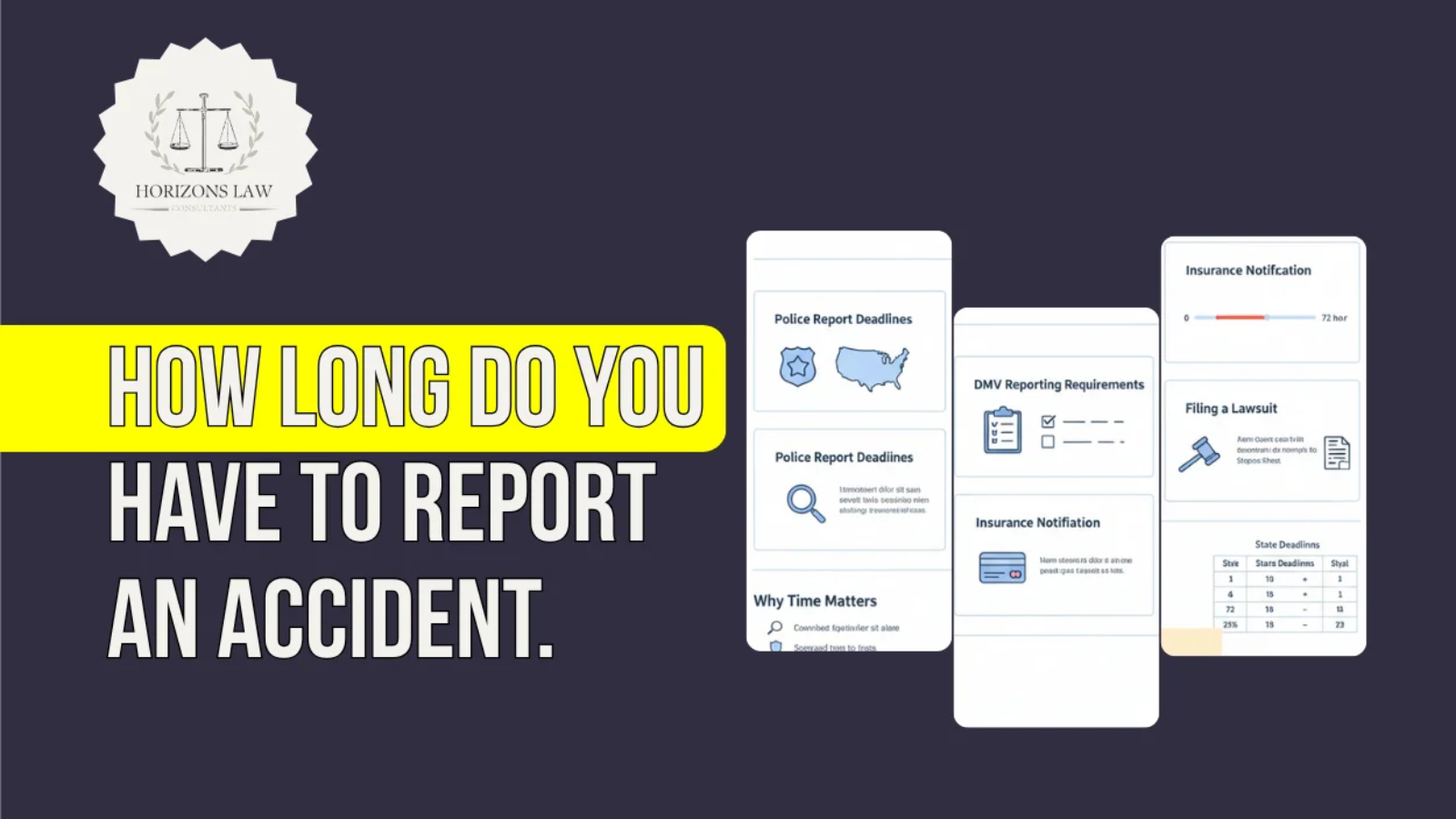
When asking how long do you have to report an accident, the short answer is: report as soon as possible. Deadlines vary by purpose (police report, DMV report, insurer notification, and lawsuit filing) and by state. Acting quickly protects evidence, preserves claims, and prevents policy denials.
Table of Contents
ToggleHow long do you have to report an accident: Insurance vs legal deadlines
A quick split view of deadlines you might face.
- Insurance notice: Prompt notice — often 24–72 hours or per policy.
- Police/DMV report: Immediate to 10 days depending on state.
- Lawsuit (statute of limitations): 1–6 years depending on jurisdiction.
Why timing matters
Time limits affect multiple outcomes:
- Insurance claims: Policies usually require “prompt” notice—often 24–72 hours—or within a few days. Delays can complicate coverage or lead to denial.
- Police/DMV reporting: Many states require a written accident report when injury or significant property damage occurs; deadlines vary (immediate to 10 days).
- Lawsuits: Statutes of limitations set the deadline to file a civil suit—commonly 1–6 years depending on state. Missing this window usually bars legal action.
Disclaimer: This article provides general information, not legal advice. For specific legal questions, consult a licensed attorney in your state.
Types of reports and who requires them
1. Police report
If anyone is injured, dies, or significant property damage occurs, call 911 or local police immediately. Some jurisdictions require you to file a formal police report at the station within a short period if an officer did not respond.
2. DMV / State accident report
Many states require drivers to submit a crash report to the DMV when damages exceed a statutory threshold or injury occurs. Deadlines range from immediately to 10 days. Examples:
- New York: report within 10 days if property damage exceeds a threshold or any injury.
- Several states: immediate reporting if injury or high damage.
3. Insurance notice
Insurance policies include a “prompt notice” or “duty to notify” clause. While exact phrasing differs, insurers expect timely notice so they can investigate. A rule of thumb: notify your insurer right away — ideally within 24–72 hours, certainly within 7–30 days depending on policy language. Even if you’re not filing a claim, telling your carrier protects coverage for later claims.
4. Filing a lawsuit (statute of limitations)
This is a legal deadline to sue for damages. It is separate from insurance notice requirements. Most states set a limit commonly 2–3 years for personal injury claims; a few allow longer (up to 6 years). Always check state-specific statutes.
State-by-state patterns (summary)

While full state tables are lengthy, patterns include:
- Immediate reporting: Many states demand immediate reporting when injury/death occurs.
- Short window (10 days): A minority (e.g., New York) require a written report within 10 days for certain damage thresholds. (Kucher Law)
- Insurance timelines: Set by contract; most insurers expect notice within days to weeks. (Stone Rose Law)
- Statutes of limitations: Range widely; commonly 2 years for personal injury in many states, but check local law. (THE702FIRM Injury Attorneys)
For precise state rules, use a reputable state-by-state guide or your state DMV website.
Practical timeline checklist (what to do, when)
- Immediately at the scene
- Call 911 if injuries or hazards exist.
- Exchange information with other drivers: names, phones, insurance, plate numbers.
- Take photos: vehicle damage, scene, skid marks, injuries, road signs, weather.
- Get witness names and contact info
- Within 24–72 hours
- Notify your insurer. Mention basic facts; avoid detailed admissions of fault.
- Seek medical attention if injured—even minor symptoms warrant a checkup.
- If required, file a police report or visit the local station to ensure an official report is recorded.
- Within days to 10 days
- File a DMV/state crash report if your state requires one (some have strict 10-day limits).
- Within weeks to month
- Keep medical records, repair estimates, and claim correspondence.
- Follow up with your insurer about claim status and next steps.
- Within statute of limitations
- If you plan to sue, retain an attorney and calendar the statute-of-limitations deadline in your state. Don’t assume you have “plenty of time.”
Insurance specifics: “prompt notice” and policy language
- Read your policy to find the notice clause. Common phrases: “prompt notice,” “as soon as reasonably possible,” or a fixed number of days (e.g., 30).
- Even if the insurer does not list a strict deadline, long delays can harm your claim: evidence fades, witness memories dim, and insurers may allege prejudice.
- If in doubt, notify the insurer and say you’re still gathering details. That preserves your right to coverage while avoiding premature admissions.
Tip: Use email or certified mail for written notice where applicable; keep copies of all communications.
When a delay might be excused
Courts sometimes excuse delayed reporting if claimant shows:
- Reasonable excuse (hospitalization, incapacitation).
- No prejudice to insurer (insurer’s investigation unaffected).
- Prompt notice given once practical.
However, relying on court sympathy is risky; timely reporting remains best practice.
Common questions (People Also Ask)
Do I have to report an accident to my insurance company?
Usually yes—policies require you to report accidents. Even if you don’t plan to file a claim, reporting preserves coverage and prevents later disputes.
What happens if I don’t report an accident?
Consequences can include denied claims, cancellation or non-renewal of policy, legal issues if state reporting laws are violated, and loss of evidence for future claims.
Can I wait to report if the damage is minor?
You can, but delay risks problems: hidden injuries may appear later, evidence gets lost, and insurers may deny claims citing late notice. Reporting early is safer.
How long do I have to file a lawsuit after an accident?
Varies by state—commonly 1–6 years. Check your state’s statute of limitations and consult an attorney early.
Drafting your report: what to include
- Date, time, and exact location of crash.
- Weather, lighting, road conditions.
- Parties involved (names, contacts, insurance, plate numbers).
- Vehicle damage descriptions and photos.
- Injuries and medical treatment sought.
- Witness info and statements if possible.
- Police officer name and report number if applicable.
Keep the report factual, concise, and avoid speculation about fault.
When to contact an attorney

Contact an attorney if:
- Serious injuries occurred.
- Disputed liability or the other driver is uninsured/underinsured.
- You face a denied claim or low settlement offer.
- Statute-of-limitations deadlines are approaching.
An attorney can protect rights, preserve evidence, and file suit before the deadline if needed.
Disclaimer: This is informational, not lawyer-client advice. Consult a licensed attorney for case-specific guidance.
Sample scripts (what to tell your insurer)
- Initial notice: “I was involved in a motor vehicle collision on [date] at [location]. No injuries reported at the scene (or describe injuries). Other party: [name]. Policy number: [#]. I am notifying you to preserve my rights.”
- Follow-up: “I want to file a claim / open an investigation. I will provide photos, repair estimates, and medical records shortly.”
Avoid admitting fault (“I’m sorry” can be interpreted as admission); stick to facts.
Special cases and nuances
- Hit-and-run: Report immediately; many states require prompt police report; insurers may cover under uninsured motorist clauses.
- Rental cars: Notify rental company per contract and your insurer.
- Work-related accidents: Employer/worker’s comp rules may apply.
- Commercial vehicles: Employers and carriers have strict reporting rules and federal/state regulations.
Detailed state examples (selected states)
Below are examples showing how state rules can differ. This is illustrative — always check your state’s official resources.
- California: You must report collisions resulting in injury, death, or property damage over $1,000 to the DMV within 10 days if a police report was not filed. Insurers expect prompt notice — usually within a few days.
- New York: Written DMV reports are required within 10 days for crashes causing injury or property damage above the statutory threshold. New York also has specific penalties for failing to report.
- Texas: Reportable crashes (injury, death, or property damage over a threshold) require reporting; however, many drivers rely on police reports at the scene. Insurance notice should be immediate.
- Florida: Serious crashes involving injury or death require immediate reporting; insurers have prompt notice requirements tied to policy language. Florida’s statute of limitations for most personal injury claims is 4 years.
- Ohio: All crashes that meet certain thresholds are reportable immediately; insurers expect timely notification and often open claims promptly to investigate.
These examples illustrate the variation; your specific thresholds and deadlines will be state-defined.
Evidence preservation: don’t lose the facts
Insurers and courts value contemporaneous evidence. Steps to preserve proof:
- Photos and videos of vehicles, damage, road signs, traffic signals, and license plates.
- Audio notes or a short video describing what happened.
- Witness contact info and short written statements (date-stamped).
- Save tow receipts and repair estimates.
- Preserve your phone records, medical receipts, and any text messages related to the crash.
If your vehicle is repairable, avoid immediate repairs until you document the damage if possible. If repairs are necessary for safety, take photos first.
Medical timeline and claims
- Seek medical care immediately for any injury. Many injuries (soft-tissue, concussions) present later. Prompt treatment ties injuries to the crash and strengthens claims.
- Keep a symptom diary: dates, pain levels, doctor visits, medications, and how injuries affect daily life.
- Maintain copies of medical bills, prescriptions, and treatment plans. These documents are essential for calculating damages and negotiating settlements.
Medical disclaimer: This content is informational. For medical advice, consult a licensed medical professional.
Negotiating with insurers after delayed notice
If you notified late and the insurer resists:
- Provide a plausible reason for delay (hospitalization, inability to access phone).
- Show no prejudice: evidence still available, witness accounts, photos taken soon after.
- Present medical records and receipts showing treatment timeline.
- Consider filing an appeal within the insurer’s appeal process.
- Consult an attorney if denial persists.
Legal doctrines like “notice prejudice” vary by state; some courts require an insurer to prove prejudice from delay to deny coverage. That said, insurers often push back on late reports.
Uninsured/Underinsured motorist claims and reporting
When the at-fault driver lacks insurance:
- Notify your insurer promptly to trigger uninsured/underinsured motorist (UM/UIM) coverage if available.
- UM/UIM claims have their own deadlines and notice requirements. Prompt reporting preserves these coverage options.
If the at-fault driver’s identity is unknown (hit-and-run), a timely police report is crucial for both criminal investigation and insurance claims.
Commercial vehicle and employer reporting
Commercial carriers and employers have stricter obligations:
- Federal hours-of-service and DOT reporting rules may apply.
- Employers often require immediate internal reporting and may have specific forms and deadlines.
- If you’re injured while driving for work, worker’s compensation rules may apply in parallel with auto claims.
Sample letter: reporting accident to insurer (formal)
[Your Name]
[Your Address]
[Date]
Claims Department
[Insurance Company Name]
[Insurance Company Address]
Re: Policy #[policy number] — Notice of Motor Vehicle Accident on [date]
Dear Claims Adjuster,
I am writing to provide notice of a motor vehicle collision that occurred on [date] at [location]. The other driver involved was [name], license plate [plate], insured under [insurer]. I sustained [describe injuries] / no injuries at the scene. A police report was filed (Report #[number]) / No officer responded; a DMV report will be filed.
I will provide photographs, medical records, and repair estimates as they become available. Please advise on next steps and claim number.
Sincerely,
[Your signature]
[Contact information]
Advanced tips for evidence and digital forensics
- Check dashcam or CCTV footage near the crash location—many businesses and traffic cameras retain short durations but can be priceless.
- Preserve your smartphone metadata; don’t delete photos or location history.
- Use timestamped cloud backups for photos (e.g., Google Photos) to prove timing.
- If possible, get an independent vehicle inspection before insurer repairs.
How long does an accident affect insurance premiums?
While not strictly a reporting question, many ask how long claims affect rates:
- Accidents commonly affect premiums for 3–5 years, depending on state and insurer practices. Some insurers have accident-free discounts after 3 years.
- Fault, severity, and your driving history influence premium increases.
Frequently overlooked deadlines
- Rental car agreements often require reporting within 24 hours.
- Lender/leaseholder notification: If your vehicle is financed or leased, notify the lienholder if the car is totaled.
- Employer reporting windows for company vehicles may be shorter than personal rules.
- Foreign travel/insurance: If crash occurs abroad, contact your insurer immediately and follow embassy/local reporting rules.
Resources and state lookup
- Your state DMV website — for crash report forms and thresholds.
- Your insurer’s policy booklet — for notice language and claim procedures.
- State bar or legal aid directories — to find local attorneys before statute deadlines.
- Reputable aggregators that track state rules — but verify against official sources.
Final steps if you receive a denial for late reporting
- Request written reason for denial.
- File an internal appeal with the insurer, providing supporting documents.
- Contact your state insurance regulator to file a complaint if the insurer acted unfairly.
- Consult counsel for potential bad-faith insurance actions where the insurer unlawfully denies coverage.
Real-world example (illustrative)
Jane is in a minor collision with $2,000 in damage and no immediate injuries. She:
- Called police — officer took basic report.
- Took photos and exchanged info.
- Notified her insurer that day (within 24 hours).
- Filed a DMV report within 7 days because state law required it.
By acting quickly Jane preserved evidence and avoided coverage disputes.
Quick reference: Do this now (one-line actions)
- Call 911 if injured.
- Exchange info and take photos.
- Notify insurer within 24–72 hours.
- File police/DMV reports if required by state—don’t miss 10-day windows.
- See a doctor. Keep records.
- Consult an attorney for serious injuries or claim disputes.
FAQs
1. How soon should I report an accident to my insurance company?
You should report it as soon as possible, ideally within 24–72 hours. Most insurance policies require “prompt notice,” and delaying may result in coverage denial or claim complications. Always check your policy’s specific terms.
2. What happens if I don’t report an accident to the police?
Failing to report can lead to fines, license suspension, or penalties, depending on your state’s laws. In some cases, it may also harm your insurance claim if the insurer needs a police report for verification.
3. How long do I have to file a lawsuit after a car accident?
This varies by state — typically 1 to 6 years under each state’s statute of limitations. If you miss this window, you usually lose the right to sue. Consult a local attorney to confirm your specific deadline.
4. Can my insurance deny a claim if I report late?
Yes. If you wait too long and the delay prejudices the insurer’s ability to investigate, they can deny your claim. However, if you have a valid reason for delay (e.g., medical emergency), some insurers may still accept it.
5. Do I have to report a minor accident with no damage or injury?
Even for minor collisions, it’s wise to report the incident to your insurer. Some damages or injuries may appear later. Reporting early protects your right to claim if hidden issues arise later.
Conclusion
Timeliness is critical when answering “How long do you have to report an accident?” Report to police/911 immediately if there are injuries. Notify your insurer as soon as possible (24–72 hours is prudent). File state/DMV reports within statutory windows (sometimes 10 days). Keep thorough documentation, seek medical care promptly, and consult an attorney for serious injuries or denials. Acting fast preserves evidence and legal rights.
Add a Comment