
What to do if your house is unlivable? — Step 1: Immediate safety (minutes to hours)
If a home is unsafe right now, your priority is people and pets, not paperwork.
Table of Contents
Toggle- Evacuate if there is fire, gas smell, structural collapse risk, flood, or immediate electrical hazard. Call emergency services (911 / local emergency number).
- For dangerous mould, sewage backup, carbon monoxide, or major leaks: leave if symptoms (headache, dizziness, breathing trouble) appear and seek medical attention. If you suspect CO, get outside immediately and call emergency services.
- Take photos and short videos from a safe distance showing hazards, smoke, floodwater, mould, or exposed wiring. Time-stamp or keep original files.
- If the issue is weather-related (storm, flood), move valuables and documents to a dry, safe place if it’s safe to do so.
Disclaimer: This section includes safety and medical prompts. If you have health symptoms, seek medical attention immediately. This article is informational, not medical advice.
Key citation: For urgent hazards and tenant emergency procedures, see government guidance on reporting unsafe housing and emergency repairs.
What to do if your house is unlivable? — Step 2: Document everything (hours to days)
Documentation is the foundation of any repair request, complaint, insurance claim, or legal action.
Do this immediately after ensuring safety:
- Photos & videos: Interiors, exterior, close-ups of damage (cracks, mould, leaks), and wide shots showing context.
- Written log: Date, time, description of event (e.g., “Sept 1 — ceiling leak in living room after heavy rain; water pooling 6 inches”). Keep notes of communications with landlord, property manager, neighbors, and emergency services.
- Collect evidence: Receipts for temporary accommodations, emergency repairs, medical bills, damaged possessions (photos + receipts).
- Preserve communications: Save emails, texts, and voicemail recordings. Print or screenshot online portals. Use registered mail or email with delivery/read receipts for formal notices.
Why documentation matters: Authorities and courts rely heavily on contemporaneous records to prove habitability breaches, code violations, and landlord neglect. See guides on how to report housing code violations and tenant remedies.
Contact the landlord/property manager (24–72 hours)
Follow this order and keep it professional but firm.
- Call first (if safe): Report the emergency, request immediate action, and note the time.
- Follow up in writing: Send a written repair request (email or certified mail) describing the problem, attaching photos, and requesting a specific remedy and timeline (e.g., “Please arrange emergency repair within 24 hours.”). Keep copies.
- Request temporary relocation or accommodation if the unit is unsafe and ask who will cover costs. Many landlords or management companies will arrange hotel or alternative housing for severe habitability failures.
Template (short):
Subject: URGENT — Repair request: [address] — [issue] — Please respond by [date/time]. Attached: photos.
If the landlord refuses or ignores the request, do not withhold action: proceed to code enforcement and legal steps below. For legal repair-and-deduct rules and timelines, see state/provincial guidance (examples: California, Ontario, Queensland).
Short-term housing & emergency relocation (hours to days)
If the unit is unlivable, immediate housing may be required.
Options (depending on circumstances and local rules):
- Landlord-provided temporary housing — ask if they will provide a hotel or alternate unit.
- Insurance — homeowners or renters insurance may include Additional Living Expenses (ALE) or Loss of Use coverage that pays for temporary housing. File a claim promptly and document expenses.
- Local relief programs — city/county emergency housing, disaster relief, or social services may assist after fires, floods, or declared emergencies.
- Friends/family or short-term rental — keep receipts. If you pay out-of-pocket and the landlord is responsible, you may seek reimbursement later.
Tip: Before paying, ask the landlord or insurer for written confirmation of reimbursement policy. For guidance on temporary housing rules and landlord responsibilities, consult local tenancy authority resources.
Legal remedies overview (repair, deduct, withhold rent, terminate lease)
Legal options vary by jurisdiction. The most common remedies:
- Repair and deduct (tenant arranges repairs and deducts cost from rent): Allowed in some U.S. states and Canadian provinces with limits and procedural steps (notice, reasonable wait). Keep all receipts.
- Withhold rent: Risky. In many places, withholding rent without following strict rules may lead to eviction. Seek legal advice first. See California and other state guidance.
- Report to code enforcement / public health / environmental health: Local authorities can inspect and order repairs or fines. This often triggers formal timelines and enforcement.
- Lease termination / constructive eviction: If the property is uninhabitable and landlord refuses to fix it, tenants may be able to end the lease and move out without penalty. Rules differ; follow official procedures and get legal advice.
- Sue for housing disrepair or damages: Tenants may sue for breach of habitability, compensatory damages, and sometimes court costs. Keep thorough proof.
Legal disclaimer: The information above provides general legal concepts, not legal advice. Laws differ by state/province/country. If legal action is contemplated, consult a qualified local attorney or tenant advice service before withholding rent, performing repairs, or terminating a lease.
Step-by-step: How to report unsafe housing & get code enforcement involved

- Attempt resolution with landlord — written notice with photos and deadline.
- If no action, contact local housing/code enforcement or environmental health — provide address, issue details, photos, and copies of notice to landlord. Officials can inspect and issue orders.
- Request inspection report — an official report strengthens claims for rent relief, repair-and-deduct, or court action.
- Follow agency directions — agencies may issue abatement orders or place deadlines on landlords. Keep agency correspondence.
- If ignored, escalate — file a formal complaint, contact a local tenants’ union or legal aid clinic, or hire an attorney.
Key sources: Guidance on reporting and remedies is available from national and local agencies (e.g., gov.uk for UK tenants, state landlord-tenant guides in US, provincial tenancy boards in Canada, RTA pages in Australia).
Country-specific quick guides
United States
- Common remedies: Repair-and-deduct (limited states), code enforcement complaints, withholding rent in narrow cases, suit for breach of implied warranty of habitability. Always follow state/city procedures.
- Federal resources: USA.gov tenant rights pages list state resources for filing complaints and finding legal assistance.
Canada
- Provincial boards: Use the Landlord and Tenant Board (Ontario) or provincial equivalents. Quebec and some provinces allow tenants to make urgent repairs and deduct or withhold amounts under conditions.
United Kingdom
- Local councils & Environmental Health: Report unfit housing; councils use HHSRS (Housing Health and Safety Rating System) to evaluate hazards. The Homes (Fitness for Human Habitation) Act also gives tenants remedies. Citizens Advice and Shelter are key help resources.
Australia
- State Residential Tenancy Acts and RTA offices: Urgent repairs are typically the landlord’s responsibility and must be fixed immediately; non-urgent repairs have statutory timelines (e.g., 14 days in some states). Contact your state’s RTA for exact rules.
Note: This is a condensed country view. Local municipal rules or city ordinances can add protections; always check your local authority.
Money & insurance: claims, receipts, and reimbursements
- Renters/homeowners insurance: File claims promptly if damage is covered (e.g., fire, certain water damage). Keep receipts for Alternative Living Expenses (ALE).
- Document replacements: Take inventories of damaged items with values and purchase receipts if possible. Insurance may reimburse depreciated value.
- If landlord pays for hotel or repairs, get written confirmation of who pays and timelines.
- If you pay for emergency repairs (when legally allowed to do so), keep receipts and a copy of the landlord notice and inspection report to support reimbursement or repair-and-deduct claims.
Financial disclaimer: Insurance policy terms differ. This is informational only — check your policy and contact your insurer or financial advisor for claims handling.
Practical templates & checklists

Short repair request (email / letter)
Subject: URGENT: Repair request — [address] — [issue]
Dear [Landlord/Manager],
On [date] I discovered [issue]. Attached are photos. This condition makes the unit unsafe/uninhabitable because [brief reason]. Please arrange emergency repair by [date/time]. If not fixed within a reasonable time, I will notify local code enforcement and seek alternative remedies.
Sincerely,
[Name, phone, date]
What to bring to an inspection or complaint
- Photos/videos (original files)
- Copies of written notices to landlord
- Logs of communication
- Receipts for temporary accommodation or emergency repairs
- Medical notes if someone was harmed
When to get legal help, and where to find it
Seek legal help if:
- Landlord threatens eviction after you complain or attempt to withhold rent.
- You’re considering withholding rent or performing repairs and deducting costs.
- You need to pursue damages for long-term disrepair or health impacts.
Where to find help:
- Legal aid and tenant advice charities (e.g., Citizens Advice UK, Shelter, local legal aid societies in the US and Canada).
- Municipal tenant services or housing departments.
- Private tenant/landlord solicitors for complex cases (disrepair lawsuits, large damage claims).
Legal disclaimer: This article does not create an attorney-client relationship. For binding legal advice, consult a licensed attorney in your jurisdiction.
Recovering after the crisis: repairs, cleaning, and health checks
- Professional remediation: For mould, sewage contamination, structural damage, hire licensed remediation. Keep certifications and receipts.
- Medical follow-up: If exposed to mould, CO, or contaminants, keep medical records. They may support claims.
- Professional home inspection: After repairs, an independent inspector can confirm habitability before you return permanently.
- Inventory recovery: For lost/damaged belongings, file claims and replace essential documents (ID, financial papers).
FAQs (short, practical)
Q: Can I stop paying rent if my house is unlivable?
A: Only in limited jurisdictions and under strict rules. Stopping rent without legal grounds risks eviction. Get legal advice first.
Q: How long should I wait for the landlord to fix emergency repairs?
A: “Reasonable time” varies—often 24–72 hours for urgent repairs; non-urgent repairs may have statutory windows (e.g., 14 days). Check local rules.
Q: Who enforces housing code violations?
A: Local housing/code enforcement offices, environmental health, or public health departments. They inspect and can issue repair orders.
Practical next steps checklist (one-page)
- Ensure safety—evacuate if necessary.
- Photograph and log damage.
- Notify landlord by phone and in writing (keep copies).
- Call local housing/code enforcement if landlord fails to act.
- Get temporary housing; save receipts.
- File insurance claims (renters/homeowner).
- Seek legal/tenant advice before withholding rent or performing repairs yourself.
- Keep all records for possible court/agency proceedings.
Resources & recommended links
- USA.gov — How to file complaint against a landlord.
- GOV.UK — Private renting: repairs and Homes (Fitness for Human Habitation). (
- Citizens Advice & Shelter (England) — Damp, mould, and complaints.
- Provincial tenancy boards (Ontario LTB brochure) and legal clinics.
- State RTA and consumer protection pages in Australia (Repairs rules).
Final notes — staying safe and protecting your rights

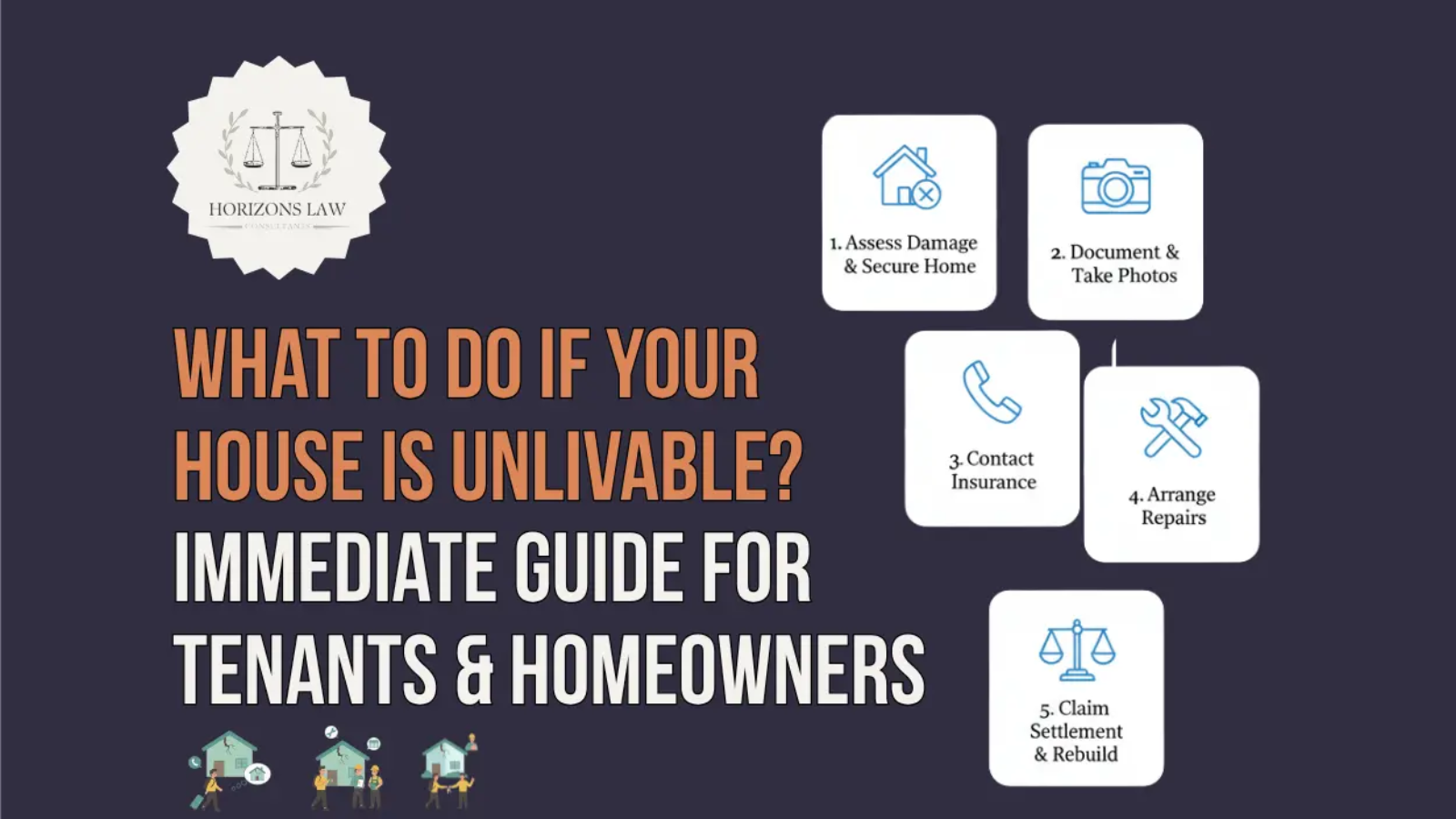
If your home becomes unlivable, act promptly: prioritize safety, document everything, notify your landlord in writing, and involve code enforcement or tenant services if repairs aren’t made. Save receipts, seek legal advice before risky actions (like withholding rent), and use official resources in your country to escalate. You don’t have to navigate this alone — tenant advice charities and legal aid services exist to help.
FAQs
1. What qualifies a house as “unlivable”?
A house is considered unlivable (or uninhabitable) when essential services or safety conditions are missing — such as no running water, electricity, heating, severe mould, structural damage, pest infestation, or toxic contamination. These conditions violate habitability standards and pose health or safety risks to occupants.
2. What should I do first if my rental becomes unsafe to live in?
Your first step is to ensure safety — evacuate if there’s a risk of fire, collapse, flooding, or gas leak. Once safe, document the damage (photos/videos) and notify your landlord immediately in writing. Keep a copy of your message and request emergency repairs or temporary accommodation.
3. Can I stop paying rent if the landlord doesn’t fix unlivable conditions?
You can only withhold rent or use repair-and-deduct in specific regions (like parts of the US, Canada, or Australia) and only after following legal procedures. Doing it incorrectly could risk eviction. Always seek legal or tenant advice before withholding rent.
4. What are my housing options if I have to leave immediately?
You can request temporary accommodation from your landlord or file a claim through renters/homeowners insurance for Additional Living Expenses (ALE). If neither applies, contact local housing authorities or tenant support services for short-term emergency housing programs.
5. Who can I report unsafe housing conditions to?
If your landlord refuses to act, report to your local housing or code enforcement office (in the US/Canada), Environmental Health department (in the UK), or Residential Tenancy Authority (RTA) (in Australia). They can inspect the property, order repairs, or impose penalties for housing code violations.
Conclusion
This article provides general information only. It is not legal, financial, or medical advice. For legal advice, contact a qualified attorney licensed in your jurisdiction. For health issues, contact a medical professional. Insurance claims should be handled with your insurer.
Add a Comment